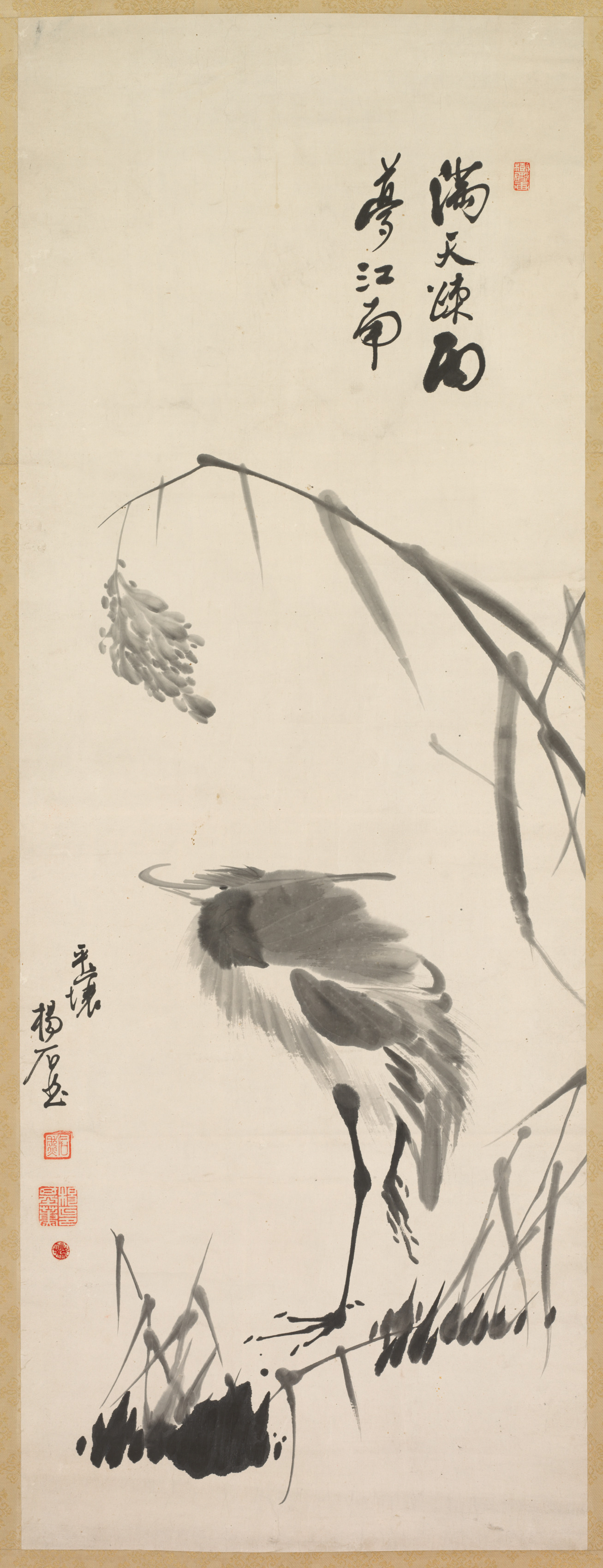
Egret and Reeds
Yang Ki-hun (Seuk-Eun) (Korean, 1843–1919?)
late 1800s
- Medium
- hanging scroll; ink on paper
- Classification
- Painting
- Dimensions
- Overall: 196 x 61 cm (77 3/16 x 24 in.)
- Culture
- Korea, Joseon dynasty (1392–1910)
- Museum
- Cleveland Museum of Art, Korean Art
- Credit line
- Gift from the Collection of George Gund III
- Rights
- Public domain (CC0), as the museum states it.
- Who can see it
- Little Ones profiles and older: it shows gentle subjects for the very young. How works are placed
View at the Cleveland Museum of Art
About this work
In this hanging scroll, an egret walks along the shores of a salt marsh where reeds abundantly grow. Native to Pyongyang, the artist Yang Ki-hun had no rival in bird-and-flower themes. The Taedong River estuary, one of Pyongyang’s beloved natural sites, may have been Yang’s favorite spot to observe and sketch various water birds.
Yang treated his subjects of flora and fauna with an observant naturalist’s view, yet his choice of subjects—an egret and reeds—is deeply rooted in traditional symbolic language: the egret stands for the scholarly reclusive life, while reeds indicate humility and modesty.