Window mode follows your eyes with your camera, in this browser only: no picture or position leaves your device.
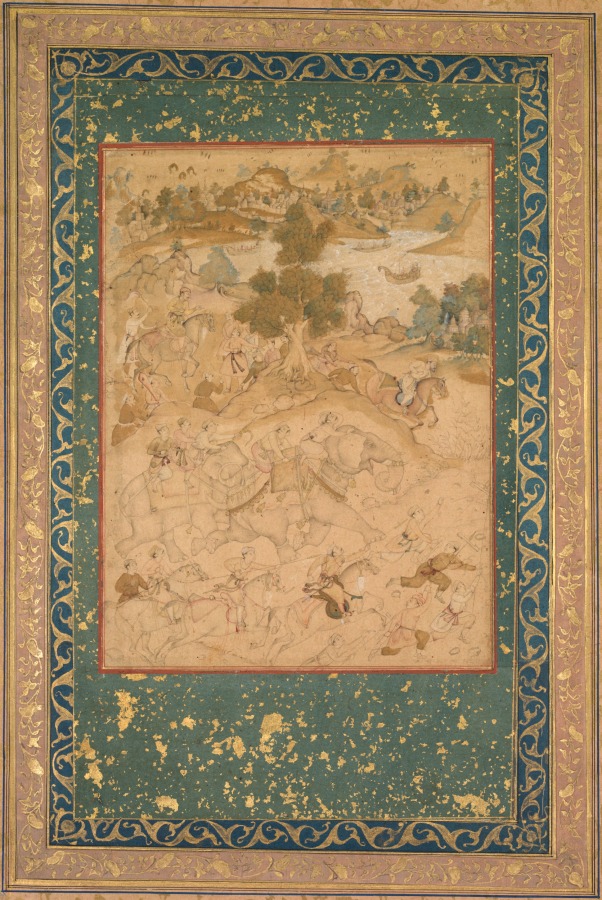
Akbar supervising the capture of wild elephants at Malwa in 1564, painting 90 from an Akbar-nama (Book of Akbar) of Abu’l Fazl (Indian 1551–1602)
attributed to Farukh Chela (Indian)
or Govardhan (Indian, active c.1596–1645)
or Dhanraj (Indian)
c. 1602–3; borders added c. 1700s
- Medium
- ink with use of colors and gold on paper, mounted on an album page with borders of gold-decorated buff and blue paper (recto); calligraphy by Faqir Ali (verso)
- Classification
- Painting
- Dimensions
- Page: 37.5 x 25.4 cm (14 3/4 x 10 in.)
- Culture
- Mughal India
- Museum
- Cleveland Museum of Art, Indian and Southeast Asian Art
- Credit line
- Gift in honor of Madeline Neves Clapp; Gift of Mrs. Henry White Cannon by exchange; Bequest of Louise T. Cooper; Leonard C. Hanna Jr. Fund; From the Catherine and Ralph Benkaim Collection
- Rights
- Public domain (CC0), as the museum states it.
- Who can see it
- Little Ones profiles and older: it shows gentle subjects for the very young. How works are placed
View at the Cleveland Museum of Art
About this work
This painting is from a biography of Akbar made shortly before his death. It depicts a historical event from early in his reign when he encountered a herd of wild elephants and captured many of them for his royal stables. Akbar rides horseback in the upper left, directing his men as two trained elephants give chase in the foreground. The Mughals caught wild elephants by chasing them with tame elephants, then tethering them together and feeding them their favorite food. European prints had made their way into Akbar’s collection, and they provided the visual source for distant cityscapes, rolling hills, and less densely colored paintings.