Window mode follows your eyes with your camera, in this browser only: no picture or position leaves your device.
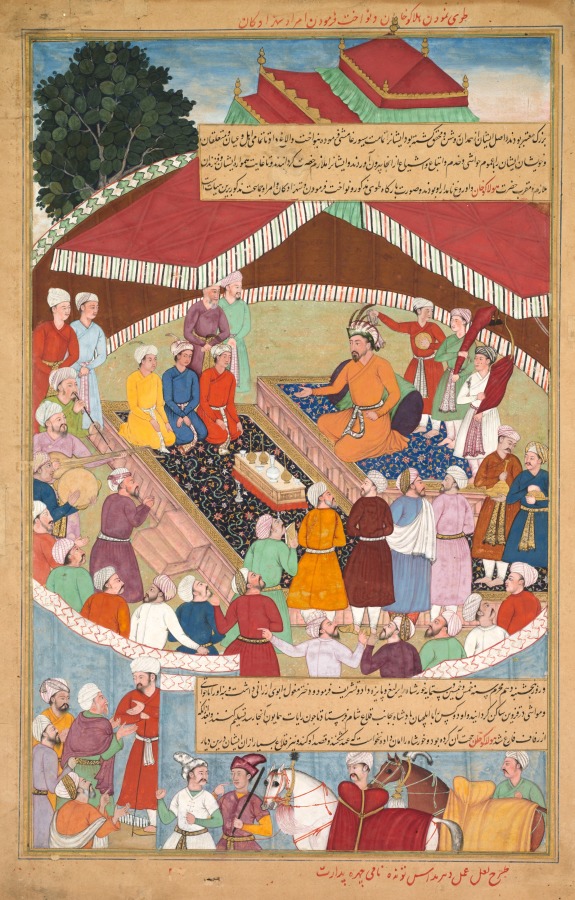
Hulagu Khan giving a feast and dispensing favor upon the amirs and princes, from a Chingiz-nama (Book of Chingiz Khan) of the Jami al-tavarikh (Compendium of Chronicles)
Lal (Indian, active c. 1555–1600)
Dharam Das (Indian, active c. 1580–1605)
Padarath (Indian, active late 1500s)
c. 1596–1600
- Medium
- Gum tempera, ink, and gold on paper
- Classification
- Painting
- Dimensions
- Page: 38.4 x 25.2 cm (15 1/8 x 9 15/16 in.); Painting: 33.3 x 21.1 cm (13 1/8 x 8 5/16 in.)
- Culture
- Mughal India
- Museum
- Cleveland Museum of Art, Indian and Southeast Asian Art
- Credit line
- Gift in honor of Madeline Neves Clapp; Gift of Mrs. Henry White Cannon by exchange; Bequest of Louise T. Cooper; Leonard C. Hanna Jr. Fund; From the Catherine and Ralph Benkaim Collection
- Rights
- Public domain (CC0), as the museum states it.
- Who can see it
- Little Ones profiles and older: it shows gentle subjects for the very young. How works are placed
View at the Cleveland Museum of Art
About this work
Seated on a lapis-blue floral carpet is Chingiz (Genghis) Khan’s grandson, who ruled Iran from 1256 to 1265. This painting is from an illustrated copy of the history of Chingiz Khan and his family that the Mughal emperor Akbar commissioned toward the end of the latter’s life. Mughal is the Persian word for Mongol, and Akbar traced direct genealogical descent from Chingiz Khan on his mother’s side.
The nomadic Mongols created court settings using portable platforms and elegant carpets and tents. Multilevel canopies of imperial crimson mark the position of the khan, which means “ruler” in Mongolian.