Window mode follows your eyes with your camera, in this browser only: no picture or position leaves your device.
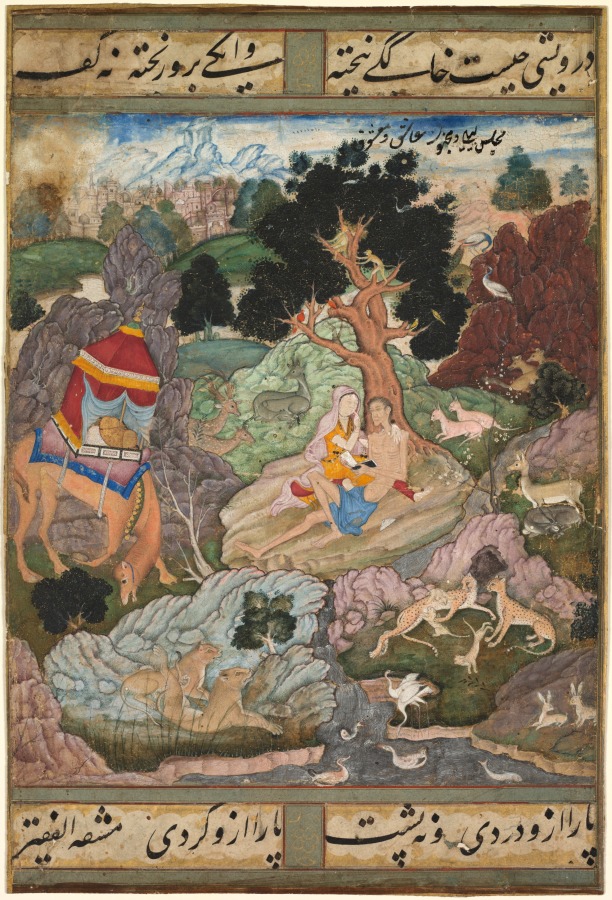
Layla and Majnun in the wilderness with animals, from a Khamsa (Quintet) of Amir Khusrau Dihlavi
attributed to Sanwalah (Indian, active c. 1580–1600)
c. 1590–1600
- Medium
- Gum tempera, ink, and gold on paper
- Classification
- Painting
- Dimensions
- Page: 24.9 x 16.8 cm (9 13/16 x 6 5/8 in.); Painting: 18.6 x 16.2 cm (7 5/16 x 6 3/8 in.)
- Museum
- Cleveland Museum of Art, Indian and Southeast Asian Art
- Credit line
- Gift in honor of Madeline Neves Clapp; Gift of Mrs. Henry White Cannon by exchange; Bequest of Louise T. Cooper; Leonard C. Hanna Jr. Fund; From the Catherine and Ralph Benkaim Collection
- Rights
- Public domain (CC0), as the museum states it.
- Who can see it
- Little Ones profiles and older: it shows gentle subjects for the very young. How works are placed
View at the Cleveland Museum of Art
About this work
Nestled in the multicolored rocks are the reunited lovers Layla and Majnun, forced by society to remain separated for years. Majnun’s name means “madman,” since the separation drove him past the brink of sanity. Exiling himself to the wilderness, he became emaciated. When Layla found him after a prophetic dream, the wild animals gathered around, drawn to the purity and depth of their love. This painting illustrates a version of the story as told by an Indian author who wrote in Persian. He altered the ending given by previous Persian authors to the ancient Bedouin tale that originated among nomadic tribes of the Arabian Peninsula, in which Layla dies before the couple can be physically reunited.