Window mode follows your eyes with your camera, in this browser only: no picture or position leaves your device.
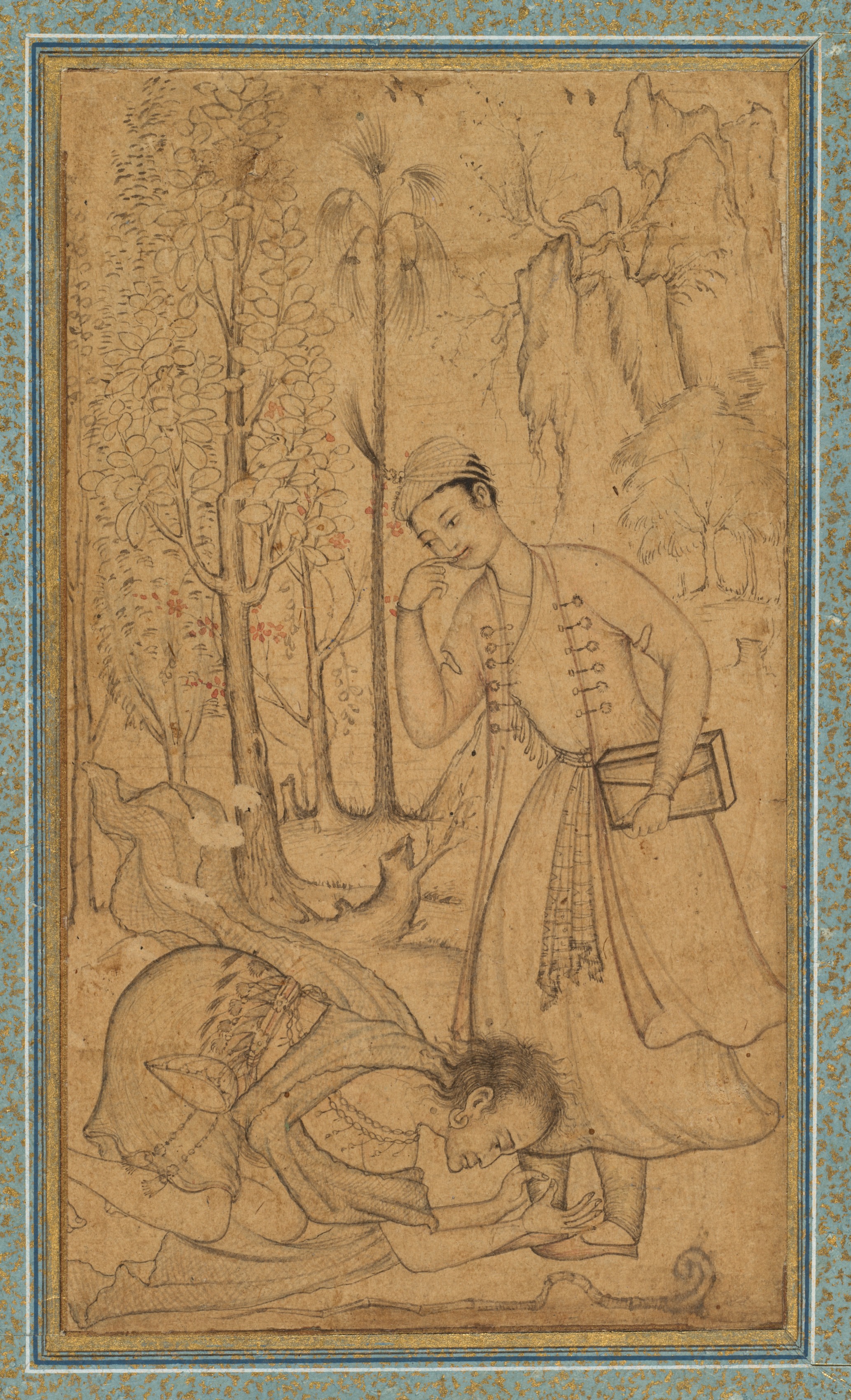
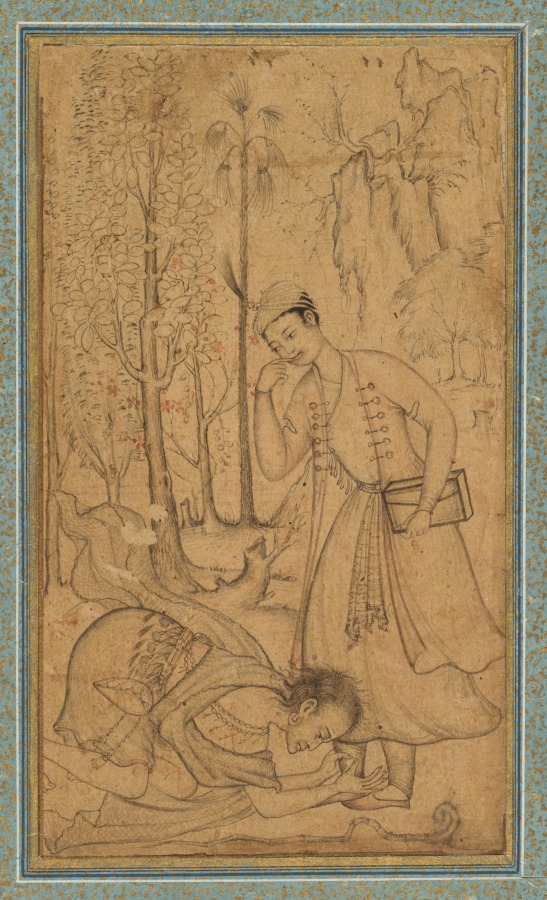
A holy man prostrating himself before a learned prince
attributed to Manohar (Indian, active late 1500s)
c. 1585; border added probably 1700s
- Medium
- ink on paper, laid down with borders of gold-decorated blue paper
- Classification
- Painting
- Dimensions
- Page: 31.5 x 19.7 cm (12 3/8 x 7 3/4 in.)
- Culture
- Mughal India, court of Akbar (reigned 1556–1605)
- Museum
- Cleveland Museum of Art, Indian and Southeast Asian Art
- Credit line
- Gift in honor of Madeline Neves Clapp; Gift of Mrs. Henry White Cannon by exchange; Bequest of Louise T. Cooper; Leonard C. Hanna Jr. Fund; From the Catherine and Ralph Benkaim Collection
- Rights
- Public domain (CC0), as the museum states it.
- Who can see it
- Tweens profiles and older: its subjects are known and suit older children. How works are placed
View at the Cleveland Museum of Art
About this work
Manohar riffs on the work of his father, Basavana, by showing a holy man bowing at the feet of a prince, instead of another holy man. Those who could recognize the relationship between this work and that of his father (CMA 2013.296) would impress gatherings of courtly connoisseurs, who prided themselves on being able to identify the hand of individual artists just by looking at the paintings. Recitation of poetry would accompany the viewing of paintings and drawings. Virtuoso artists reflected glory on their patrons. As an Islamic ruler, Akbar and his court participated in these activities—a new purpose for art that Indian artists had to learn.