Window mode follows your eyes with your camera, in this browser only: no picture or position leaves your device.
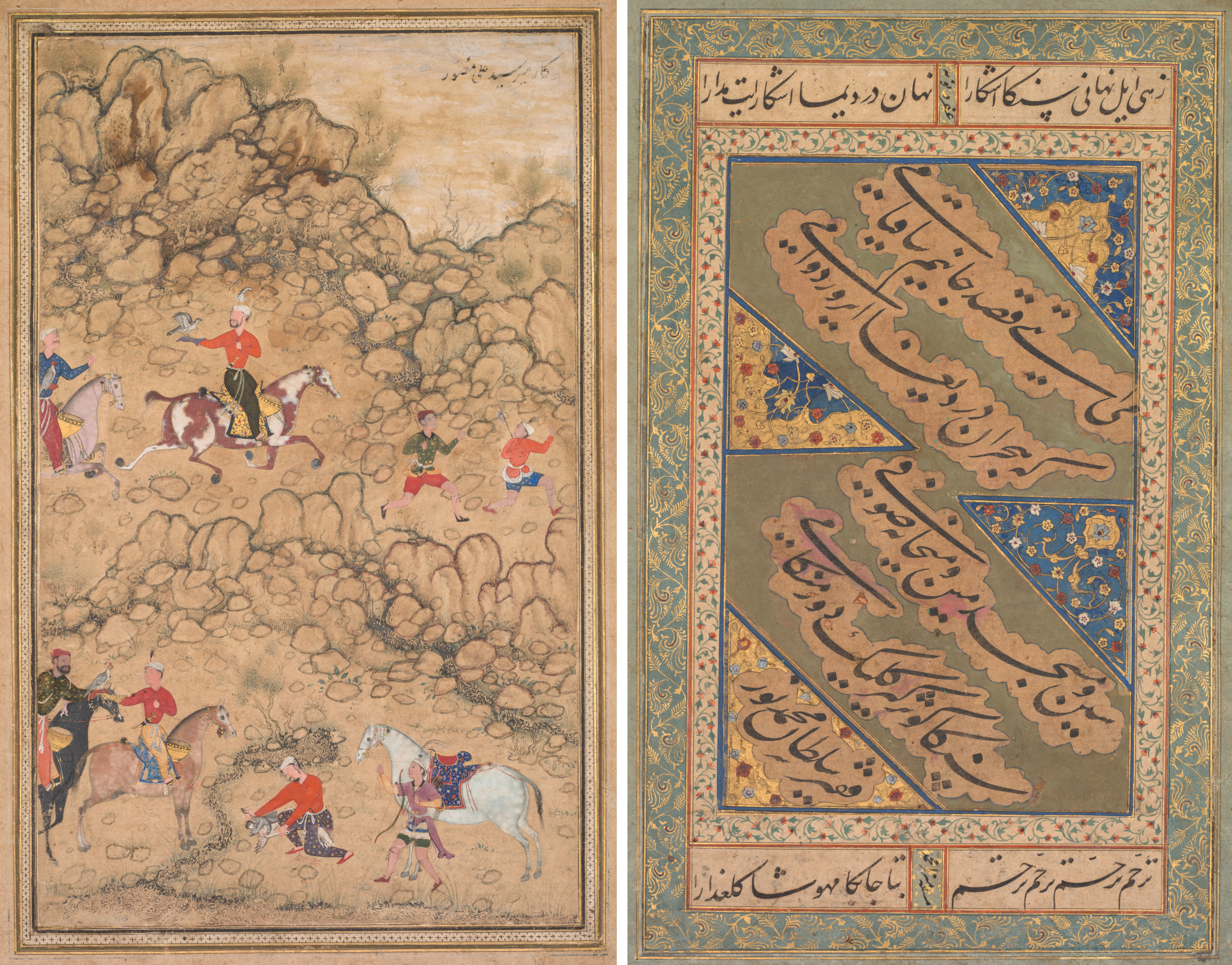
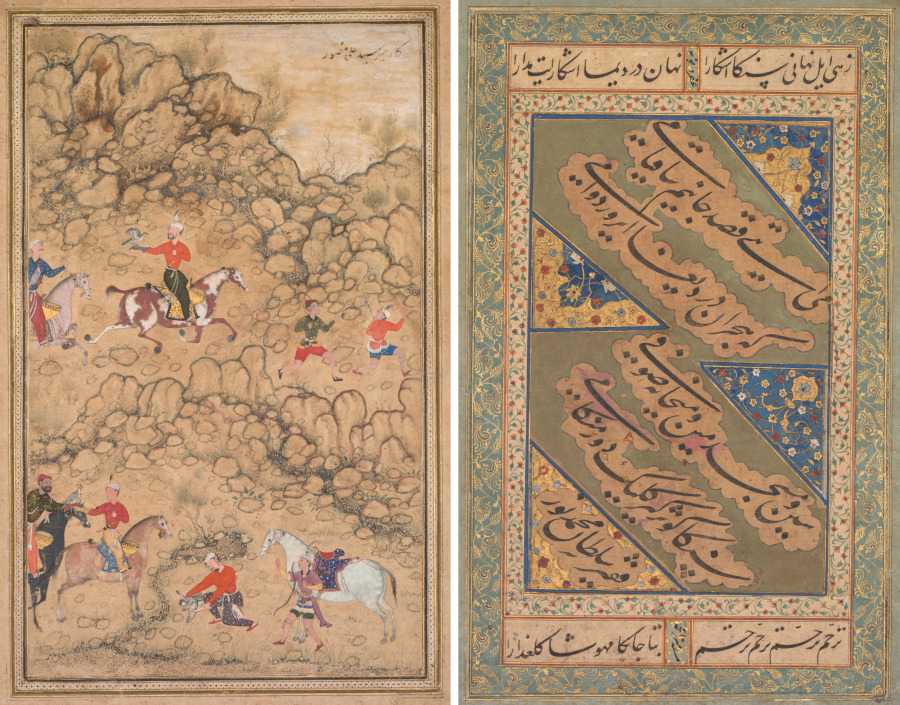
Hunting with falcons in a landscape; verso: Calligraphy of Chaghatai Turkish poems in praise of wine, Sultan Muhammad Nur (Persian, c. 1472–1536) and Mirza Muhammad (probably Persian, active c. 1520s)
attributed to Abd al-Samad (Persian, c. 1510–1600)
c. 1558–60; borders added probably 1700s
- Medium
- Gum tempera, ink, and gold on paper
- Classification
- Painting
- Dimensions
- Page: 35.7 x 24.3 cm (14 1/16 x 9 9/16 in.); Painting: 21.5 x 13 cm (8 7/16 x 5 1/8 in.)
- Culture
- Mughal India, court of Akbar (reigned 1556–1605)
- Museum
- Cleveland Museum of Art, Indian and Southeast Asian Art
- Credit line
- Gift in honor of Madeline Neves Clapp; Gift of Mrs. Henry White Cannon by exchange; Bequest of Louise T. Cooper; Leonard C. Hanna Jr. Fund; From the Catherine and Ralph Benkaim Collection
- Rights
- Public domain (CC0), as the museum states it.
- Who can see it
- Teens profiles and older: its subject is for older viewers (war, death, the Passion, drink or the like). How works are placed
View at the Cleveland Museum of Art
About this work
The Mughals hunted on horseback with falcons. The hunting party would ride out into the wild and flush the prey. Then, its hood removed, the falcon would chase the prey and bring it down. From childhood Akbar loved hunting, and this painting may be a rare depiction of Akbar as a youth at the lower left, with the black feather in his white turban. The falcon that has caught a duck has been hooded and is being passed between the young man and his bearded companion. This important work was painted by one of the Persian artists Akbar’s father brought to India from Iran. The inscription at the upper right gives the name of one of the other Persian artists, but it is probably an erroneous later addition.
This page of delicately illuminated calligraphy from the pre-Mughal period was mounted into a Mughal album. The poems are written in the native language of the Mughals, a form of Turkish called Chaghatai, using a flowing form of Arabic script called nasta‘liq. The Mughals self-consciously adopted Persian as their official court language, so few Chaghatai books or works of calligraphy were made for them. The quatrain in the center reads: The wine has made an attempt on my life, Since…