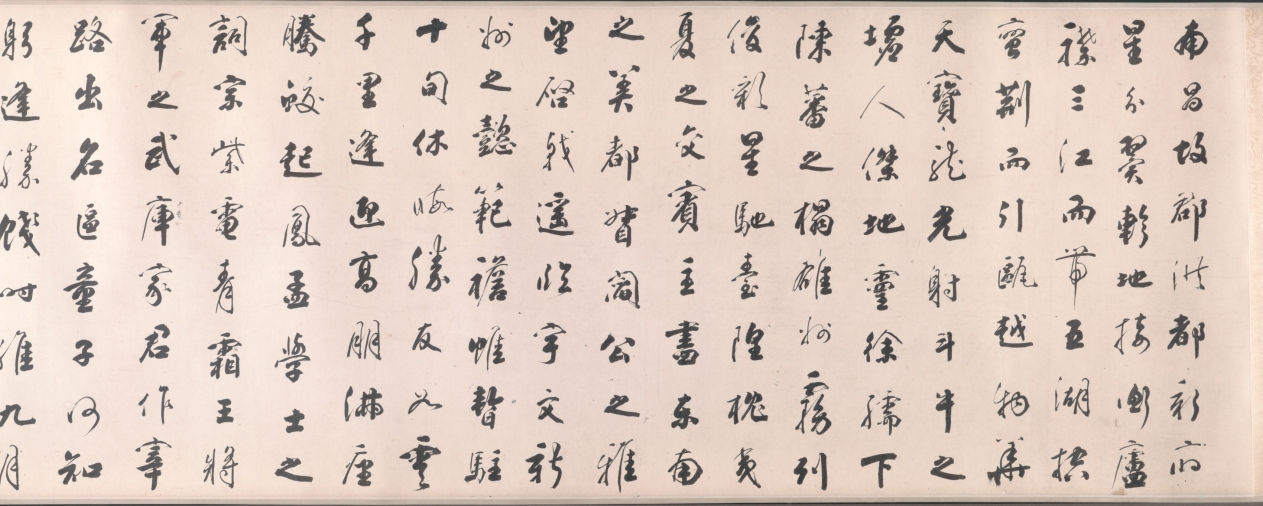
Poem on Plum
copy after Yi Hwang (Korean, 1501–1570)
1700s–1800s
- Medium
- hanging scroll; ink on paper
- Classification
- Calligraphy
- Dimensions
- Overall: 115 x 68.2 cm (45 1/4 x 26 7/8 in.); Painting only: 46 x 52.7 cm (18 1/8 x 20 3/4 in.)
- Culture
- Korea, Joseon dynasty (1392–1910)
- Museum
- Cleveland Museum of Art, Korean Art
- Credit line
- Seventy-fifth anniversary gift of The Honorable Joseph P. Carroll and Roberta Carroll, M.D.
- Rights
- Public domain (CC0), as the museum states it.
- Who can see it
- Tweens profiles and older: its subjects are known and suit older children. How works are placed
View at the Cleveland Museum of Art
About this work
For Yi Hwang, a celebrated scholar and poet in Korea in the 1500s, writing poems was an escape from partisan politics. Because its flowers often bloom in the middle of winter, Joseon period Korean scholars like Yi found plum blossoms a perfect subject to express the value of endurance and self-cultivation. In his numerous poems, Yi used plum blossom imagery to express his feelings. The poem on this hanging scroll reads: “Wishing to fly away, red leaves left the mountain villa. Their large sleeves are frosted due to blue clouds. The clouds in the sky look upright, which are beyond human beings’ ability. The plum tree whispered to me that [the leaves] fell from the wind and landed on the fence.” The mountain villa in this poem may refer to the Dosan Academy, a Confucian school that Yi established after his retirement, and the red leaves of the plum blossom are probably Yi’s poetic personification.