Window mode follows your eyes with your camera, in this browser only: no picture or position leaves your device.
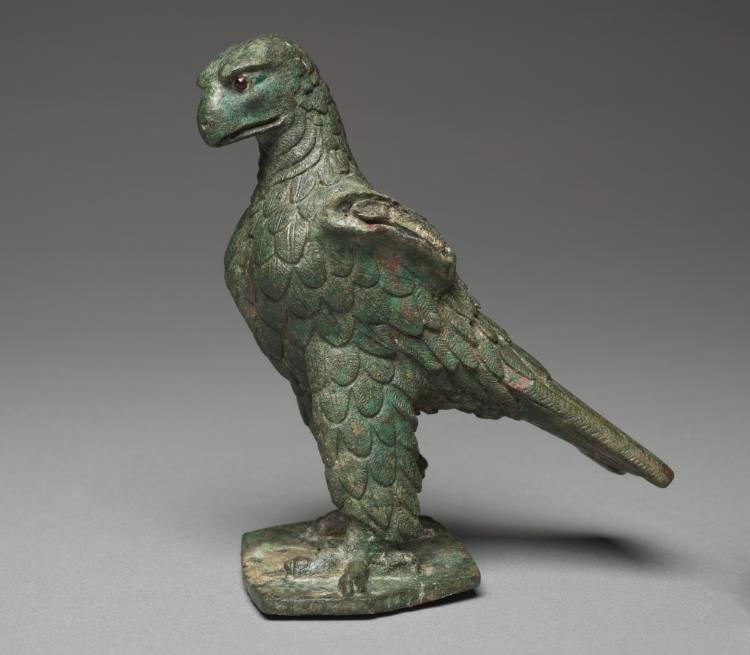
Imperial Eagle
100 BCE–100 CE
- Medium
- bronze with garnet inlays
- Classification
- Sculpture
- Dimensions
- Overall: 12.1 x 6.9 x 9.7 cm (4 3/4 x 2 11/16 x 3 13/16 in.)
- Culture
- probably Syria, Roman
- Museum
- Cleveland Museum of Art, Greek and Roman Art
- Credit line
- John L. Severance Fund
- Rights
- Public domain (CC0), as the museum states it.
- Who can see it
- Little Ones profiles and older: it shows gentle subjects for the very young. How works are placed
View at the Cleveland Museum of Art
About this work
This eagle stands on an integrated bronze base with overlapping ovoid-shaped feathers creating a layered pattern across its body, and its tail feathers fanned out. The wings, now lost, were likely cast separately in bronze and then soldered or welded to the bird’s body. The eyes are inlaid with red stones believed to be garnets. The eagle is associated with Jupiter, king of the gods, and the Roman poets Virgil and Horace described the birds as the bearers of his thunderbolt. While eagles were often depicted on Roman coins, the bird is rarely depicted in the round in Roman art.