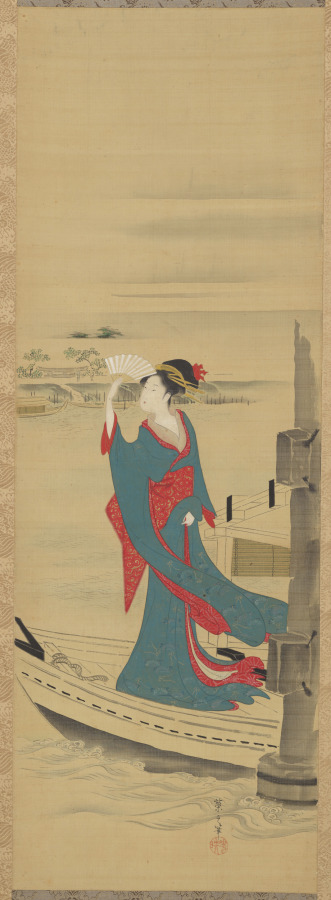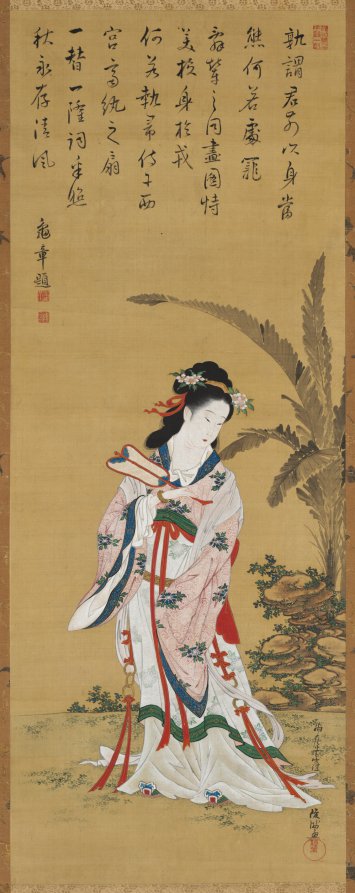
Chinese Beauty
Kubo Shunman (Japanese, 1757–1820)
late 1700s–early 1800s
- Medium
- Hanging scroll; ink and color on silk
- Classification
- Painting
- Dimensions
- Image: 96 x 37 cm (37 13/16 x 14 9/16 in.); Overall: 184.2 x 53.3 cm (72 1/2 x 21 in.)
- Culture
- Japan, Edo period (1615–1868)
- Museum
- Cleveland Museum of Art, Japanese Art
- Credit line
- Kelvin Smith Fund
- Rights
- Public domain (CC0), as the museum states it.
- Who can see it
- Teens profiles and older: its museum says too little about what it shows to place it for younger viewers. How works are placed
View at the Cleveland Museum of Art
About this work
Ukiyo-e artists’ exploration of beautiful people extended to figures from other lands. Here, an elegant Chinese palace lady holding a fan stands before a banana plant. The poem at the top is written in a Japanese appropriation of Chinese called kanbun. Based on its imagery of a palanquin (an enclosed couch with poles used for carrying passengers), silk fan, and autumn winds, it may allude to the story of Lady Ban (about 48 BC–about AD 2). A Chinese beauty famous for her scholarly achievements, Ban was once consort to an emperor but later lost his favor. In a poem attributed to her, she compared herself to a used silk fan put away in autumn.