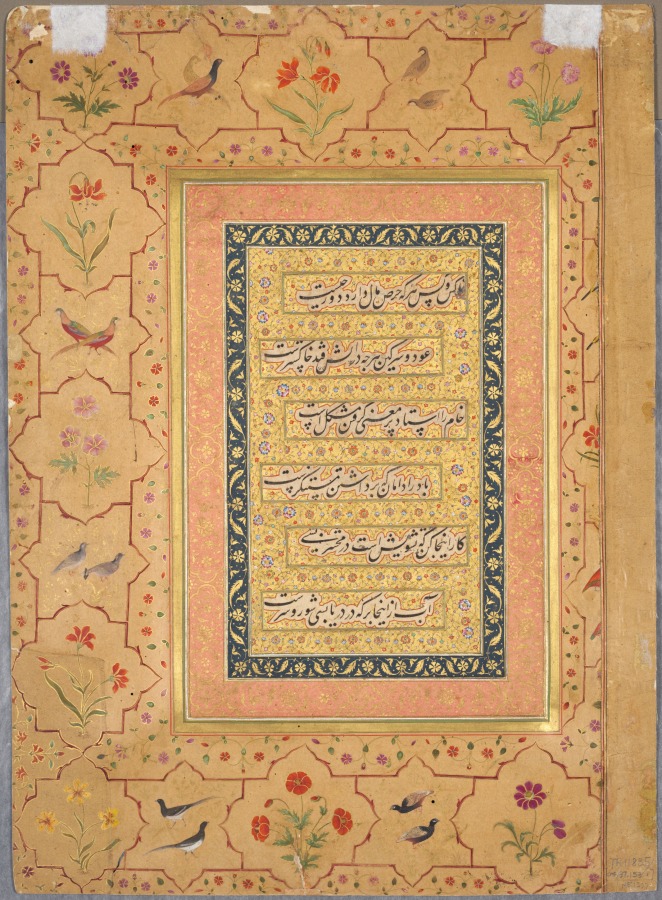
Calligraphy framed by an ornamental border with poppies and pairs of birds, from the Late Shah Jahan Album (verso)
c. 1653
- Medium
- Gum tempera, ink, and gold on paper
- Classification
- Painting
- Dimensions
- Overall: 37.8 x 27.3 cm (14 7/8 x 10 3/4 in.)
- Culture
- Mughal India, court of Shah Jahan (reigned 1628–58)
- Museum
- Cleveland Museum of Art, Indian and Southeast Asian Art
- Credit line
- Gift of Mr. and Mrs. Alton W. Whitehouse
- Rights
- Public domain (CC0), as the museum states it.
- Who can see it
- Little Ones profiles and older: it shows gentle subjects for the very young. How works are placed
View at the Cleveland Museum of Art
About this work
Treated as a jewel set in gold and floral arabesques, this work is an example of how Mughal patrons held the art of calligraphy in higher esteem than figural painting. This work is unsigned, so the calligrapher remains unknown, but the lines are excerpts from a didactic ode composed by Amir Khusrau (1253–1325) of Delhi, known as the "Parrot of India," one of the most accomplished authors of the Persian language in India.
The text itself reads: "Anyone, whether noble or ignoble, who covets wealth, is destined for hell. Aloe-wood and dung, once thrown in the fire, turn to ash. It is hard for an unrefined mind to master sophisticated thought. For the wind to lift up the feet of a mountain is impossible. See to your tasks here and now, for there is mayhem on the Day of Judgment. Draw your water from here, for there is much tumult and mischief out in the sea."