Window mode follows your eyes with your camera, in this browser only: no picture or position leaves your device.
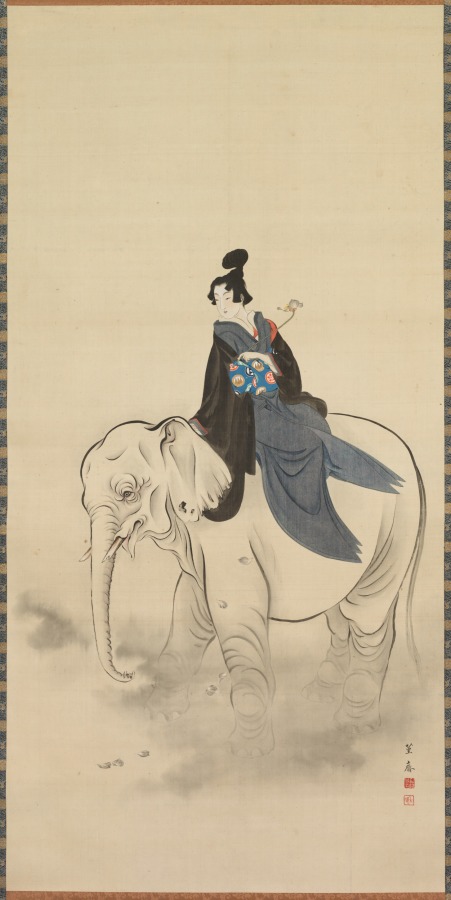
Stand-in Fugen
Kitao Masayoshi (Japanese, 1761–1824)
late 1700s–early 1800s
- Medium
- hanging scroll; ink and color on silk
- Classification
- Painting
- Dimensions
- Painting only: 114.3 x 56.2 cm (45 x 22 1/8 in.); Including mounting: 186.7 x 76.2 cm (73 1/2 x 30 in.)
- Culture
- Japan, Edo period (1615–1868)
- Museum
- Cleveland Museum of Art, Japanese Art
- Credit line
- The Kelvin Smith Collection, given by Mrs. Kelvin Smith
- Rights
- Public domain (CC0), as the museum states it.
- Who can see it
- Teens profiles and older: its museum says too little about what it shows to place it for younger viewers. How works are placed
View at the Cleveland Museum of Art
About this work
Here, a woman dressed as a man replaces Fugen, a bodhisattva—a being among those considered enlightened in Buddhism—who symbolizes learning as a path to awakening and typically rides an elephant. The painting teaches the lesson of impermanence through the petals falling from the lotus flower the woman holds. It also alludes to the legend of Eguchi, a 12th-century courtesan who, following an encounter with a Buddhist monk-poet called Saigyō, revealed herself to be a manifestation of Fugen.