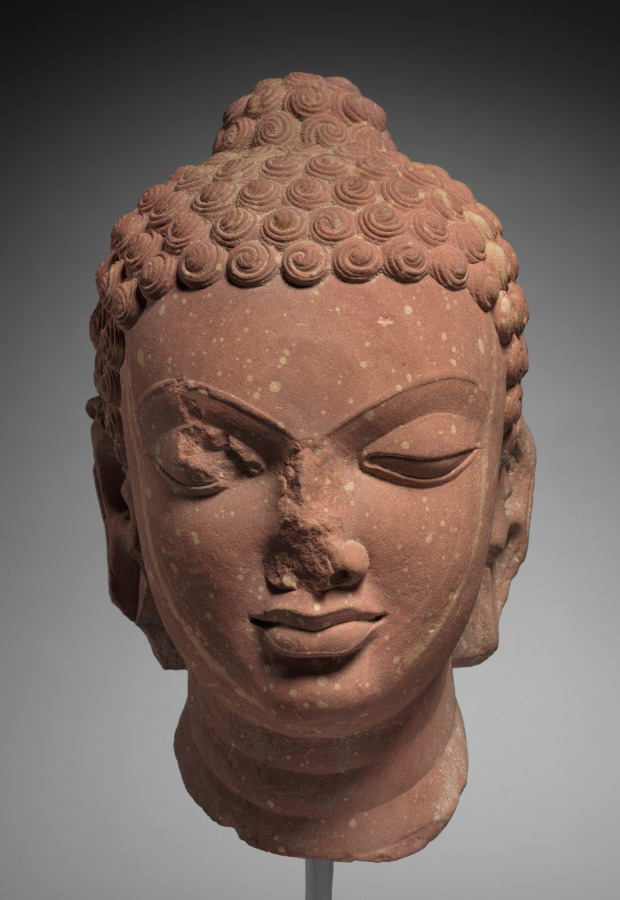
Head of Buddha
400s CE
- Medium
- sandstone
- Classification
- Sculpture
- Dimensions
- Overall: 30.6 x 16.6 cm (12 1/16 x 6 9/16 in.)
- Culture
- Northern India, Uttar Pradesh, Mathura
- Museum
- Cleveland Museum of Art, Indian and Southeast Asian Art
- Credit line
- John L. Severance Fund
- Rights
- Public domain (CC0), as the museum states it.
- Who can see it
- Tweens profiles and older: its subjects are known and suit older children. How works are placed
View at the Cleveland Museum of Art
About this work
The brows arch with tension and alertness, though the lids are half closed. Short curls cover his head and cranial protuberance, which during this period came to be interpreted as a mark of one who has reached enlightenment, his state of awareness having surpassed the boundaries of an ordinary human being. Sculptors working during the time when kings of the Gupta dynasty (c. 319–550 CE) ruled northern India achieved a balance between fleshy volumes and idealized linear features. This balance led scholars to consider the Gupta period to be a “classical” age of Indian art.