Window mode follows your eyes with your camera, in this browser only: no picture or position leaves your device.
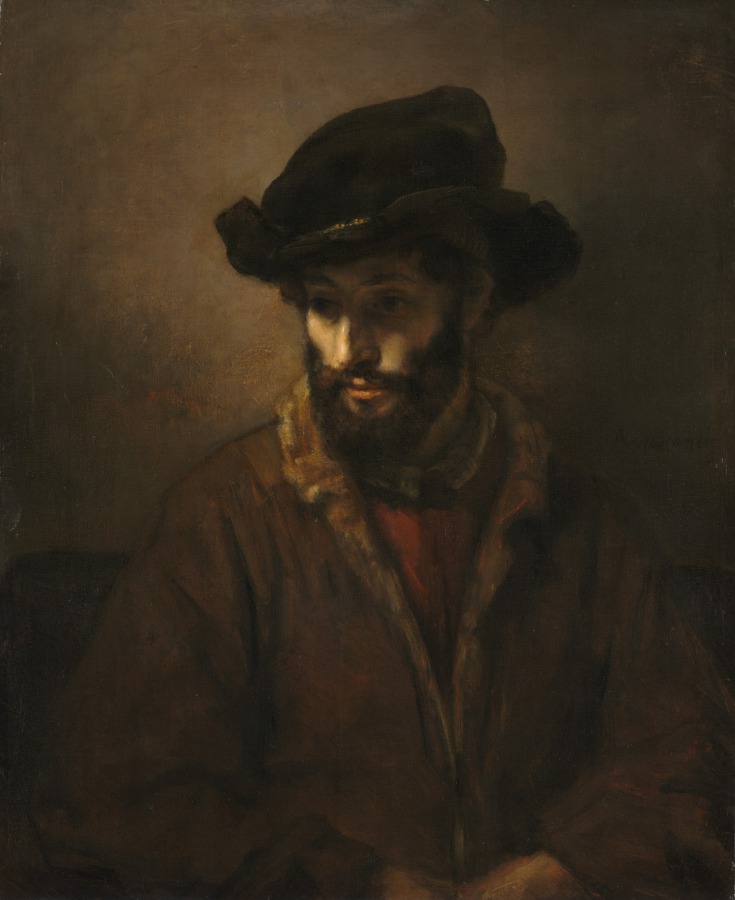
A Bearded Man Wearing a Hat
studio of Rembrandt van Rijn (Dutch, 1606–1669)
c. 1655–60
- Medium
- oil on canvas
- Classification
- Painting
- Dimensions
- Framed: 119.4 x 104.1 x 14.6 cm (47 x 41 x 5 3/4 in.); Unframed: 84.5 x 69.2 cm (33 1/4 x 27 1/4 in.)
- Culture
- Netherlands
- Museum
- Cleveland Museum of Art, European Painting and Sculpture
- Credit line
- Gift of the Hanna Fund
- Rights
- Public domain (CC0), as the museum states it.
- Who can see it
- Tweens profiles and older: its subjects are known and suit older children. How works are placed
View at the Cleveland Museum of Art
About this work
Amsterdam of the early 1600s was a religiously tolerant city, attracting many Jewish settlers of both Sephardic (Spanish and Portuguese) origin and Ashkenazic (Eastern European) descent. Rembrandt lived among both denominations and found inspiration in the manner and dress of the Ashkenazim, who maintained traditional comportment and attire and were less affluent than their Sephardim counterparts. As a result, many of the unidentified portraits from Rembrandt's late period once carried Jewish associations, but because of a lack of sufficient evidence, those assignations have since been reconsidered. Such is the case with Portrait of a Man, which was once considered a portrait of the Dutch Jewish philosopher Baruch Spinoza (1632–1677) as well as a representation of a Jewish student. Rembrandt's authorship of the painting has also undergone reassessment. The broad and thinly painted cloak and hat suggests the painting is likely a workshop product and while it does display Rembrandt's characteristic interest in a sitter's introspection, the figure's thoughtfulness remains comparatively superficial.