Window mode follows your eyes with your camera, in this browser only: no picture or position leaves your device.
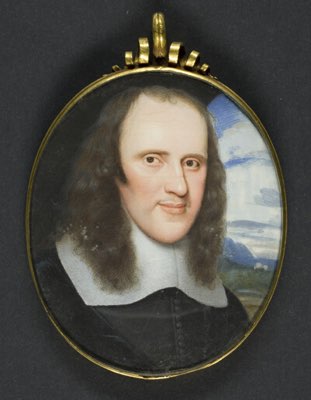
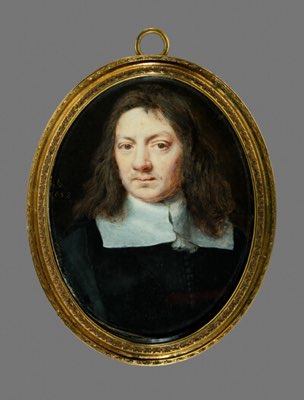
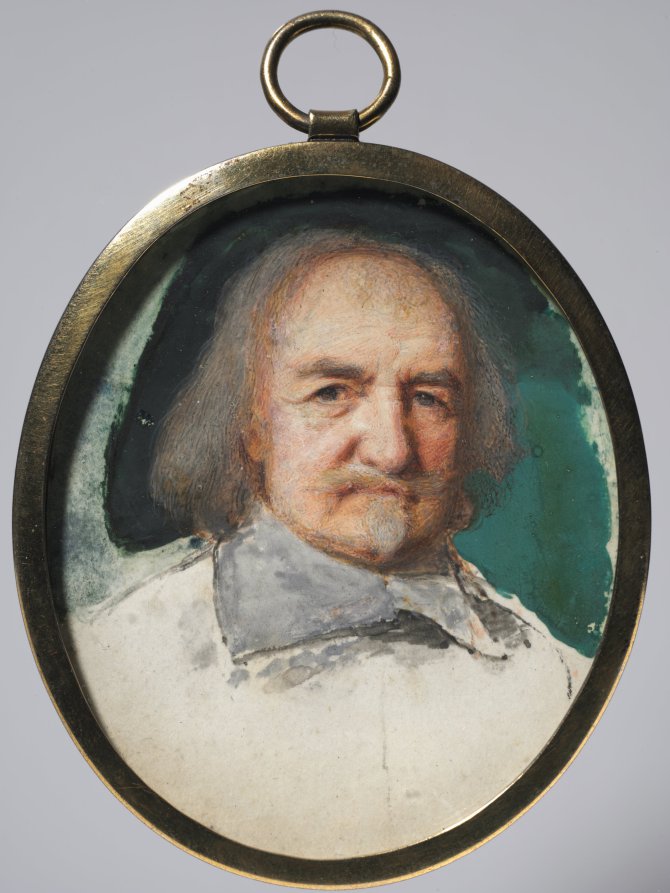
Portrait of Thomas Hobbes
Samuel Cooper (British, 1608/09–1672)
c. 1660
- Medium
- watercolor on vellum in a gilt metal frame
- Classification
- Portrait Miniature
- Dimensions
- Framed: 7.3 x 6.3 cm (2 7/8 x 2 1/2 in.); Sight: 6.7 x 5.8 cm (2 5/8 x 2 5/16 in.)
- Culture
- England, 17th century
- Museum
- Cleveland Museum of Art, European Painting and Sculpture
- Credit line
- The Edward B. Greene Collection
- Rights
- Public domain (CC0), as the museum states it.
- Who can see it
- Tweens profiles and older: its subjects are known and suit older children. How works are placed
View at the Cleveland Museum of Art
About this work
In his seventies when the portrait was painted, Thomas Hobbes (1588–1679) is turned slightly to his left, his eyes directed at the spectator. He has thin gray hair extending to his collar and a gray mustache and goatee. Only his head is finished; a thin gray wash loosely describes a plain, flat collar. Hobbes was born in Malmesbury, Wiltshire. In spite of humble parentage, he rose to prominence as a brilliant linguist and author of the 1651 book Leviathan, a seminal work of social contract theory that advocated for government led by a strong sovereign. As a royalist he was forced to flee England when the civil war broke out in 1642, and he resided in France until the war’s end in 1651. He was a friend of Cooper, who painted his miniature on at least two occasions.