Window mode follows your eyes with your camera, in this browser only: no picture or position leaves your device.
Sarcophagus
c. 100–125 CE
- Medium
- Greek marble
- Classification
- Sculpture
- Dimensions
- Overall: 210 cm (82 11/16 in.)
- Culture
- Italy, Rome, Roman Empire
- Museum
- Cleveland Museum of Art, Greek and Roman Art
- Credit line
- Gift of the John Huntington Art and Polytechnic Trust
- Rights
- Public domain (CC0), as the museum states it.
- Who can see it
- Teens profiles and older: its museum says too little about what it shows to place it for younger viewers. How works are placed
View at the Cleveland Museum of Art
About this work
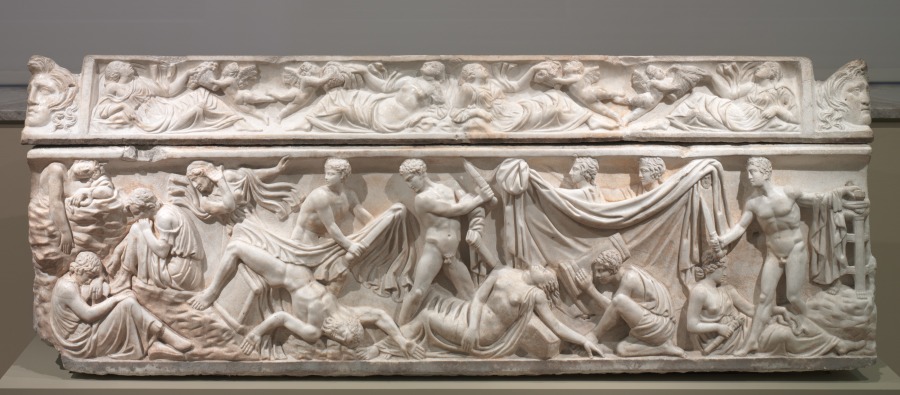
The tragic figure Orestes appears three times on the front of this sarcophagus, always wielding a short sword. In the center he stands over the body of his mother Clytemnestra, and at center left over the body of her lover Aegisthus. Orestes has killed them both to avenge their murder of his father Agamemnon, upon his return from years of fighting at Troy. At the far left, three Furies (avenging spirits) rest upon Agamemnon's tomb, while at the far right, Orestes atones for the murders at the Delphian shrine of Apollo, marked by a tripod and rock. On the lid, four reclining women symbolize the seasons, arranged in right-to-left order: Winter, Spring, Summer, Autumn, as indicated by their dress and the contents of their baskets.