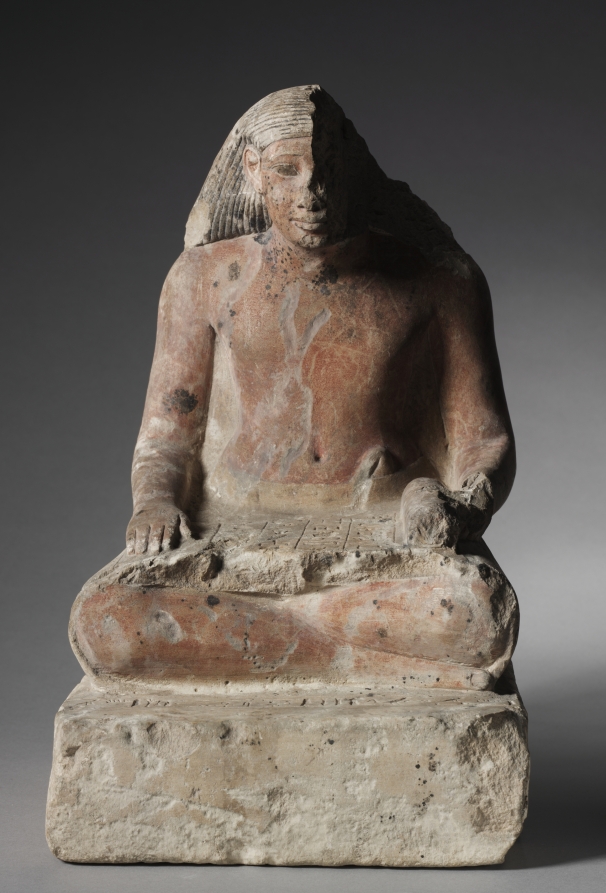
Seated Scribe of Medthu
c. 1479–1425 BCE
- Medium
- limestone, originally painted
- Classification
- Sculpture
- Dimensions
- Overall: 30.5 x 18.9 x 24.1 cm (12 x 7 7/16 x 9 1/2 in.)
- Culture
- Egypt, New Kingdom (1540–1069 BCE), Dynasty 18, reign of Tuthmosis III (1479–1425 BCE)
- Museum
- Cleveland Museum of Art, Egyptian and Ancient Near Eastern Art
- Credit line
- Gift of the John Huntington Art and Polytechnic Trust
- Rights
- Public domain (CC0), as the museum states it.
- Who can see it
- Teens profiles and older: its museum says too little about what it shows to place it for younger viewers. How works are placed
View at the Cleveland Museum of Art
About this work
Medthu, the overseer of the two granaries and scribe of accounts of the fields of Amen, sits cross-legged on the ground in the traditional pose of a scribe. His striated, bell-shaped wig, the stripes of which run parallel to his forehead, completely reveals his ears and passes behind his shoulders. His short, belted kilt is stretched tight to support he papyrus that is partly unrolled across his lap. He holds the rolled-up portion with his left hand, and his right hand rests flat on the papyrus, which curls around his right thigh. The papyrus is inscribed in sunk relief with seven columns of hieroglyphs that face the scribe. The Middle Kingdom type of wig helps date the statue more closely to the earlier part of Dynasty 18, around the time of Tuthmosis III. Later in Dynasty 18 the coiffure was fashionably updated.