Interior. The Music Room, Strandgade 30
Vilhelm Hammershøi (Danish, 1864–1916)
1907
- Medium
- Oil on canvas
- Classification
- Painting
- Dimensions
- 70 × 59 cm (27 9/16 × 23 1/4 in.); Framed: 85.5 × 75.3 × 8.9 cm (33 5/8 × 29 5/8 × 3 1/2 in.)
- Culture
- Denmark
- Museum
- Art Institute of Chicago, Painting and Sculpture of Europe
- Credit line
- Joseph Winterbotham Collection
- Rights
- Public domain (CC0), as the museum states it.
- Who can see it
- Tweens profiles and older: its subjects are known and suit older children. How works are placed
View at the Art Institute of Chicago
About this work
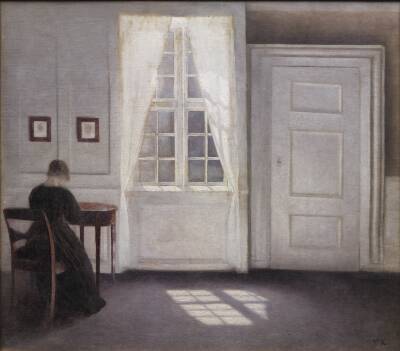
On September 15, 1898, Vilhelm Hammershøi and his wife Ida moved to an apartment on the upper floor of Strandgade 30 in Copenhagen, where they remained until 1909. This stay coincided with the most productive period of the artist’s career, during which he painted his best-known series of works: ever-evolving variations on the interior of his apartment. Hammershøi regularly depicted this corner of his drawing room, both with and without the figure of Ida. For the artist, the apartment was akin to a stage set, and he used furniture and household objects like props, endlessly positioning and repositioning them not according to their domestic function but rather to their aesthetic effect.
In Interior. The Music Room, Strandgade 30, a minimal arrangement featuring musical instruments is illuminated by soft light filtering through a window just outside the frame. But without a human presence to animate the instruments, the scene evokes only silence. Carefully painted with small, flickering brushstrokes, the picture embodies the poet Rainer Maria Rilke’s observation that “Hammershøi is not one of those about whom one must speak quickly. His work is long and slow, and at whichever…
Description © Art Institute of Chicago, CC BY 4.0