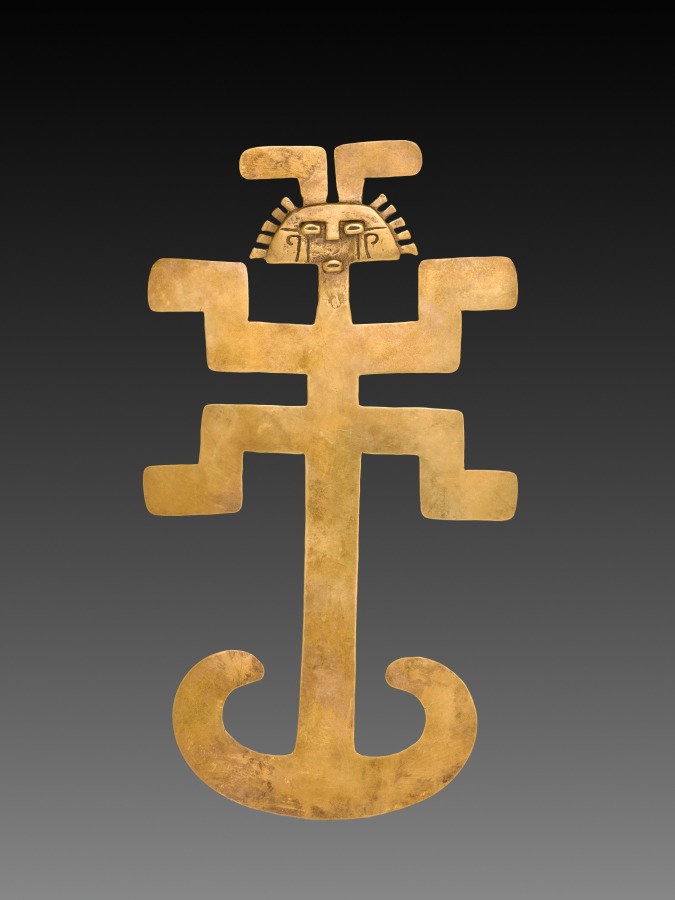
Gold Pectoral with Zoomorphic Face
Chavín (North coast, Peru)
c. 500 BCE
- Medium
- Gold
- Classification
- Metalwork
- Dimensions
- 27.9 × 25.4 cm (11 × 10 in.)
- Culture
- Peruvian North Coast
- Museum
- Art Institute of Chicago, Arts of the Americas
- Credit line
- Joanne M. and Clarence E. Spanjer and Curator’s Discretionary funds
- Rights
- Public domain (CC0), as the museum states it.
- Who can see it
- Tweens profiles and older: its subjects are known and suit older children. How works are placed
View at the Art Institute of Chicago
About this work
The archaeological site of Chavín de Huántar, high in a valley in the northern Andes of Peru, was a seat of economic, political, and religious power, giving rise to art and symbolic imagery that deeply affected the Andean world between 900 and 200 BCE. The rulers of Chavín brought about a cultural synthesis, adapting architectural and sculptural forms that had been associated with ruler-ship by the urban coastal societies of Peru for at least a thousand years. Artists created a new imagery, deriving forms from both the human figure and dominant predators—caymans, harpy eagles, jaguars, and pumas, some of them native to the Amazon forests east of the Andes mountains. These animal and anthropomorphic icons were often combined in a fearsome visual vocabulary. Expressed in imposing architectural reliefs, monumental three-dimensional sculptures, textile designs, and splendid ritual attire and portable objects, this symbolic imagery was emblematic of Chavín priestly rulers and the warrior aristocracy, affirming their spiritual connections with the domain of animal powers and the deified forces and phenomena of nature. Chavín art was a distinctly Andean expression of the cosmological…
Description © Art Institute of Chicago, CC BY 4.0