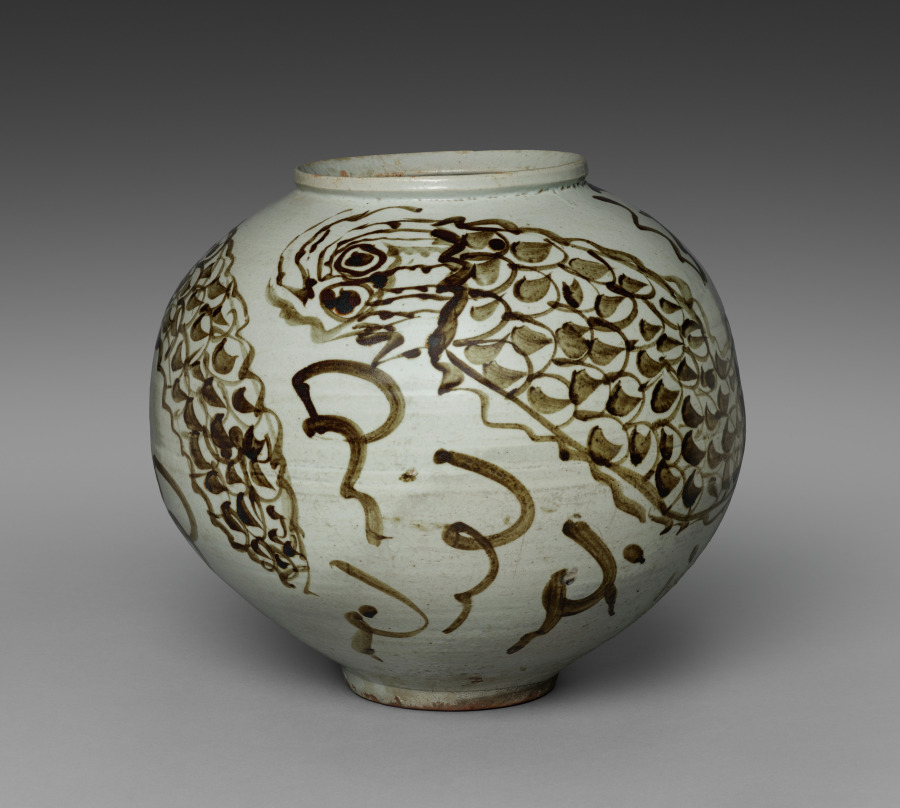
Moon Jar
Joseon dynasty (1392–1897), late 17th– mid-18th century
- Medium
- Porcelain with glaze
- Classification
- Vessel
- Dimensions
- 33 × 32.5 cm (13 × 12 13/16 in.); Diam.: 32.5 cm (12 13/16 in.)
- Culture
- Korea
- Museum
- Art Institute of Chicago, Arts of Asia
- Credit line
- Gift of an anonymous donor, Louise Lutz Estate, and Russell Tyson Endowment
- Rights
- Public domain (CC0), as the museum states it.
- Who can see it
- Little Ones profiles and older: it shows gentle subjects for the very young. How works are placed
View at the Art Institute of Chicago
About this work
This large, milky white jar, made during Korea’s Joseon dynasty, is called a moon jar because of its distinctive shape and color. In order to build the jar’s large round shape, Joseon potters joined two hemispherical halves in the center. The joint is almost visible under the smooth white glaze but subtly flattens out between the halves. This moon jar, like many others, has mysterious spots—possibly residue from liquid the jar once contained or the result of a crystal growth from the slow cooling of the kiln. Either way, these stains have become a part of the identity of Joseon moon jars.
Description © Art Institute of Chicago, CC BY 4.0