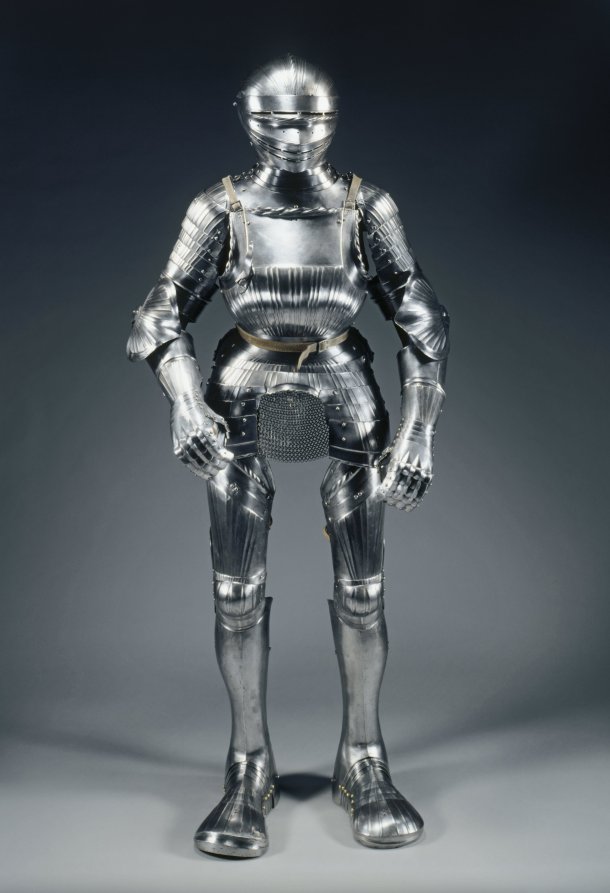
Portions of a Field Armor
Jacob Halder (Royal Workshops of Greenwich, England)
c. 1588
- Medium
- Steel, brass, gilding, leather, and silk velvet textile
- Classification
- Armor
- Dimensions
- H. (mounted with arm defenses): 61 cm (30 in.) Wt. 39 lb. 10 oz. (17.7 kg)
- Culture
- Greenwich
- Museum
- Art Institute of Chicago, Applied Arts of Europe
- Credit line
- George F. Harding Collection
- Rights
- Public domain (CC0), as the museum states it.
- Who can see it
- Little Ones profiles and older: it shows gentle subjects for the very young. How works are placed
View at the Art Institute of Chicago
About this work
During the late Middle Ages and Renaissance, some of the finest armorers worked exclusively for royal patrons in the workshops set up to meet their needs. In 1511 King Henry VIII of England established such a workshop at Greenwich Palace outside London, which produced outstanding armor for the English court for over a century. It was staffed largely by German craftsmen, among them Jacob Halder, who was master workman at Greenwich when this half-armor was produced around 1588–90. Made for a high-ranking nobleman, it features crisply decorated bands of etching and gilding and a silhouette mimicking fashionable dress. The shape of the breastplate, broad at the shoulders, narrow at the waist, and dipped at the belly, imitates the peasecod (peapod-shaped) cut of a gentleman’s doublet of the same period. Despite the lavish decoration and exaggerated shape, this armor, intended for the field of battle, was capable of withstanding musket fire. Indeed, it was commissioned in 1588, at the very moment England was preparing for invasion by the Spanish Armada. But to the fashionable noble who commissioned this harness, demonstrating wealth and status was as important as protecting life and…
Description © Art Institute of Chicago, CC BY 4.0