Window mode follows your eyes with your camera, in this browser only: no picture or position leaves your device.
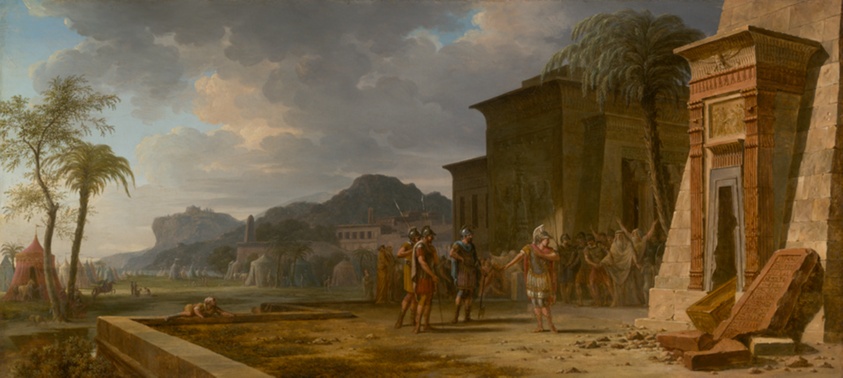
Alexander at the Tomb of Cyrus the Great
Pierre Henri de Valenciennes (French, 1750–1819)
1796
- Medium
- Oil on canvas
- Classification
- Painting
- Dimensions
- 42 × 91.1 cm (16 9/16 × 35 7/8 in.); Framed: 59.3 × 107.7 cm (23 5/16 × 42 3/8 in.)
- Culture
- France
- Museum
- Art Institute of Chicago, Painting and Sculpture of Europe
- Credit line
- Purchased with funds provided by Mrs. Harold T. Martin
- Rights
- Public domain (CC0), as the museum states it.
- Who can see it
- Teens profiles and older: its subject is for older viewers (war, death, the Passion, drink or the like). How works are placed
View at the Art Institute of Chicago
About this work
This landscape and its companion piece, Mount Athos Carved as a Monument to Alexander the Great, reflect the late-18th-century enthusiasm for the antique, as well as the cult of sensibility that made the tomb in a landscape a favored subject for art in this period. Here Alexander, who overthrew the Persian Empire, arrives at the tomb of its founder, Cyrus the Great (590/580–c. 529 B.C.), only to find that it has been desecrated. In choosing the subjects of this pair of moralizing landscapes, Pierre-Henri de Valenciennes was doubtless suggesting the transitory nature of empire and of life itself.
Description © Art Institute of Chicago, CC BY 4.0